
Using AI to Build Systems in Your Startup

3x founder · Coach to 500+ founders
A founder I work with spent three hours every week copying customer data between tools. His team called it “the sync ritual.” Nobody questioned it. Everyone just did it.
He asked me if AI could fix it. I said probably. But before we touched a single tool, I asked him to map the whole process on a whiteboard.
Twenty minutes in, he discovered that eight of twelve steps existed to fix a data entry error from 2022. The error had been resolved. The steps were still running.
They deleted those steps. Then automated the remaining four.
That saved more time than any AI tool could have.
The myth that’s costing you
AI adoption among early-stage startups has exploded. Every tool you use now has AI built in: your CRM, your support software, your design tools, your email client. The pressure to “use AI” is everywhere.
Most founders respond by adding tools. A new AI assistant here. An automation layer there. A ChatGPT integration for customer support. And then they wonder why nothing feels faster.
The problem isn’t the tools. It’s the order of operations.
You can’t AI your way out of a broken process. Automating chaos makes it faster to produce chaos.
The founders moving fast with AI right now are not using more tools. They’re using fewer, with more intention.
AI enforces discipline
Here’s the frame that actually works: AI doesn’t save time. It enforces discipline.
When you hand a task to an AI system, you have to define it precisely. What’s the input? What’s the output? What counts as success? What are the edge cases?
Most founders can’t answer those questions. Not because they’re bad operators, but because those tasks have never been defined. They run on institutional memory and gut calls.
That’s where AI creates unexpected value. It forces you to document a task before you can automate it. And in doing that work, you often discover the task is broken, redundant, or half of what it should be.
The best AI implementations in startups don’t look like “AI projects.” They look like operations work that happens to use AI at the end.
The 4D audit: decide before you automate
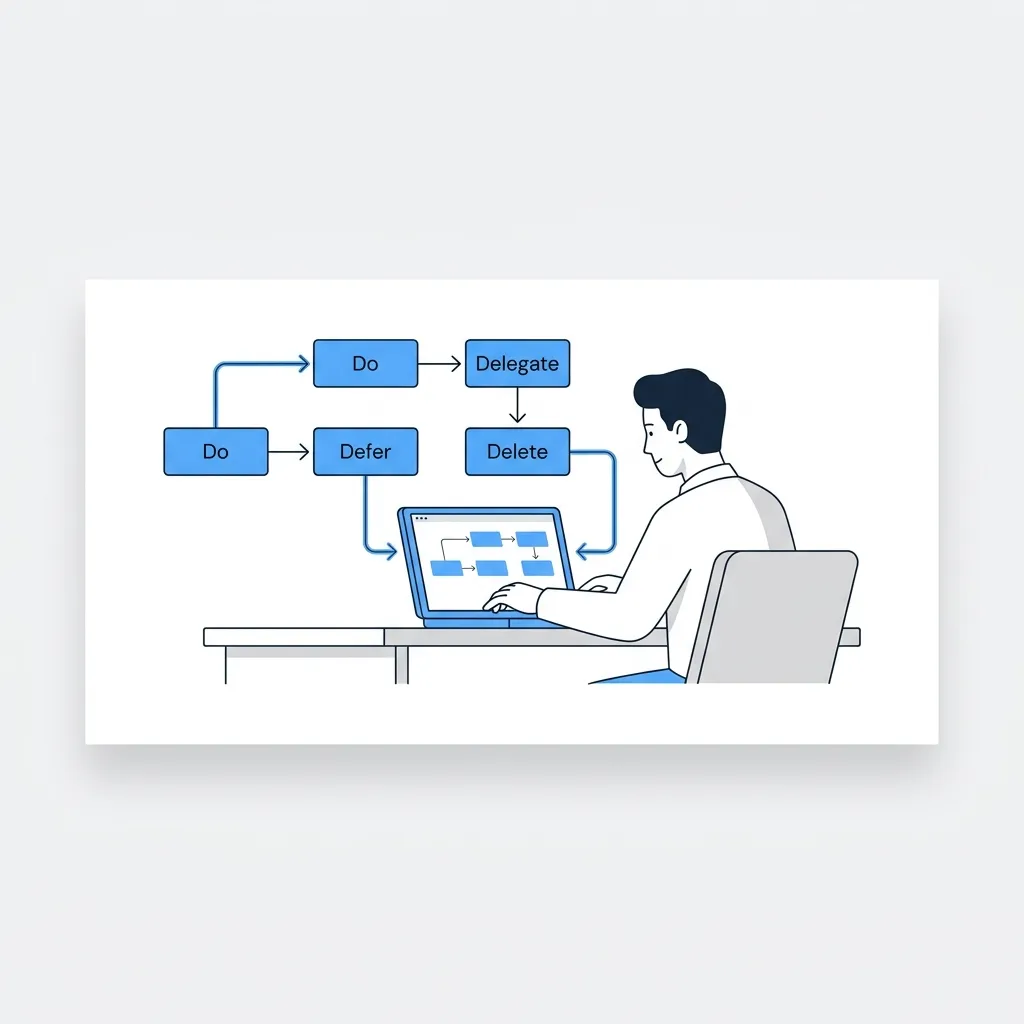
Before you open a single AI tool, run a task audit. Take every repeatable thing you or your team does and assign it one of four labels.
Do. This requires your judgment, your relationships, your intuition. Investor conversations. Difficult customer calls. Product direction. Product-market fit decisions. AI can assist, but you’re driving.
Delegate. Rule-based, repeatable, no real judgment required. Triaging support tickets. Scheduling social posts. Summarizing meeting notes. Drafting first-pass responses. These are your prime AI candidates.
Defer. The process is too undefined to hand off yet. Document it first. Once you can write it as a checklist another person could follow, it’s ready for automation.
Delete. It exists because no one stopped doing it. Kill it before you consider automating it.
The typical founder who runs this audit finds that 30 to 40 percent of their team’s operational time is in Delegate territory. That’s where AI earns its place.
The mistake is jumping to Delegate without first clearing out what belongs in Delete. You do not want a fast, reliable system for producing something nobody needed.
Three places to start
Start with customer-facing systems
The fastest return on AI at an early-stage startup is usually in customer-facing operations, not internal ones.
Why? Because customer interactions are high-volume, repetitive, and directly tied to retention. Every support email that goes unanswered is a churn risk. Every onboarding step that breaks is a user who never activates.
Practical places to start:
- Support triage. Tools like Intercom have AI built in to categorize tickets, suggest responses, and handle common questions before a human touches them.
- Onboarding follow-up. An automated sequence triggered by user behavior keeps new users on track without requiring someone to monitor a dashboard.
- Lead routing. A form submission can be scored and routed in seconds rather than waiting for someone to log in on Monday morning.
A founder I work with was personally approving every customer support email before it went out. Every one. At 11pm. He thought it was quality control. It was a bottleneck dressed up as care.
We mapped the emails. Eighty percent were answers to the same twelve questions. We documented a response guide. His support lead used AI to draft against it. Within three weeks, the support lead was handling 90 percent of tickets solo. Churn went down.
It was not a technology change. It was a systems change. The AI was the last step.
Match the AI to the layer
Different AI tools work at different layers of your operation. Knowing which layer you’re targeting saves you from buying tools that overlap or conflict with each other.
- Content and communication. Claude or ChatGPT for drafting, editing, summarizing, and rewriting. Zapier or n8n to move content and data between tools.
- Code and product. Cursor for writing and debugging code. GitHub Copilot for teams with existing development workflows.
- Research and analysis. Perplexity or Claude for competitive and market research. Your BI tool (Metabase, Looker) for structured data questions.
- Workflow automation. n8n if you want open-source flexibility your team controls. Zapier if you want something your non-technical team can manage without support.
Pick the layer where you have the most daily pain. Don’t try to automate all four at once.
Build for handoff, not dependency
The AI systems that break fastest are the ones nobody understands except the person who built them.
Every workflow you build should have a human who can take it over when it fails. And it will fail. A prompt stops working. An API changes. A new exception shows up that the system was not designed to handle.
Build documentation as you build the system. Write out the checklist the AI is following. Name the person responsible for auditing the output weekly. Set up a simple alert for when the output looks wrong.
AI that nobody trusts is AI that nobody uses. Trust comes from legibility.
Proof it works when you get the order right
Mark ran an AI hiring tool. Technically strong, better than most of what was out there. He had five paying users in three months.
The tool was not the problem. His go-to-market was.
He rebuilt his outreach as a system: LinkedIn sequences targeting recruiters, niche content about specific hiring bottlenecks, placement in an HR newsletter. He used AI to draft and schedule each piece, with a human reviewing and personalizing before anything went out.
Within a month, he had 100 paying users.
The AI did not find his customers. The system did. AI made the system run faster.
Where AI systems break
AI automation fails predictably. Three failure modes come up constantly:
Messy source data. Garbage in, garbage out. If your CRM is incomplete, AI triage produces confident wrong answers. Clean the source before you automate anything downstream.
Too many exceptions. If your team says “well, it depends” more than twice when describing a single process, that process is not ready. Define the exceptions first. Then automate.
No human in the loop. Fully automated systems that nobody audits will drift. Someone has to review AI output regularly and flag what’s wrong. Build that review into the workflow from the start.
If you’re hitting any of these, the fix is almost never “better AI.” It’s better process.
The No BS Startup Growth Playbook applies the same approach across every growth function. It covers the operations patterns that compound fastest at each stage.
If you want to identify which systems in your specific operation are ready for AI and which ones need cleaning up first, the free strategy call is the right place to start. Thirty minutes. No slides. We look at your actual workflows.
The founders getting the most out of AI right now did not start with AI. They started with a clear picture of what they were actually doing.
Related startup guides
Use the startup guide to see where AI systems fit in the full company-building sequence. The first functions worth automating are the ones already working: customer onboarding and pricing are two early candidates where good defaults compound fastest.
Related Startup Guides
All articlesScale
Build Systems in Your Startup: No-Code Tools Are the Key
No-code isn't about building cheap. It's about proving real demand before you spend months on engineering. Here is the 2026 stack and when to use each layer.
Scale
How to Find Investors and Raise Startup Funding in 60 Days
Find the right investors, build a pitch deck that earns meetings, and run cold outreach that books calls. The 3-step process behind an $8.5M YC S25 raise.
Lead
How to Make Hard Business Decisions You Won’t Second-Guess
Hard business decisions are fear problems, not strategy problems. The Clarity Compass gives founders a repeatable way to decide and stand behind the call.
Farzad Khosravi
No BS Startup Coach · 500+ Founders Coached
I help early-stage founders launch, grow, and lead with clarity. I cut through the noise to the few tactics that actually change your numbers. I've coached 500+ founders across validation, growth, leadership, and fundraising.