
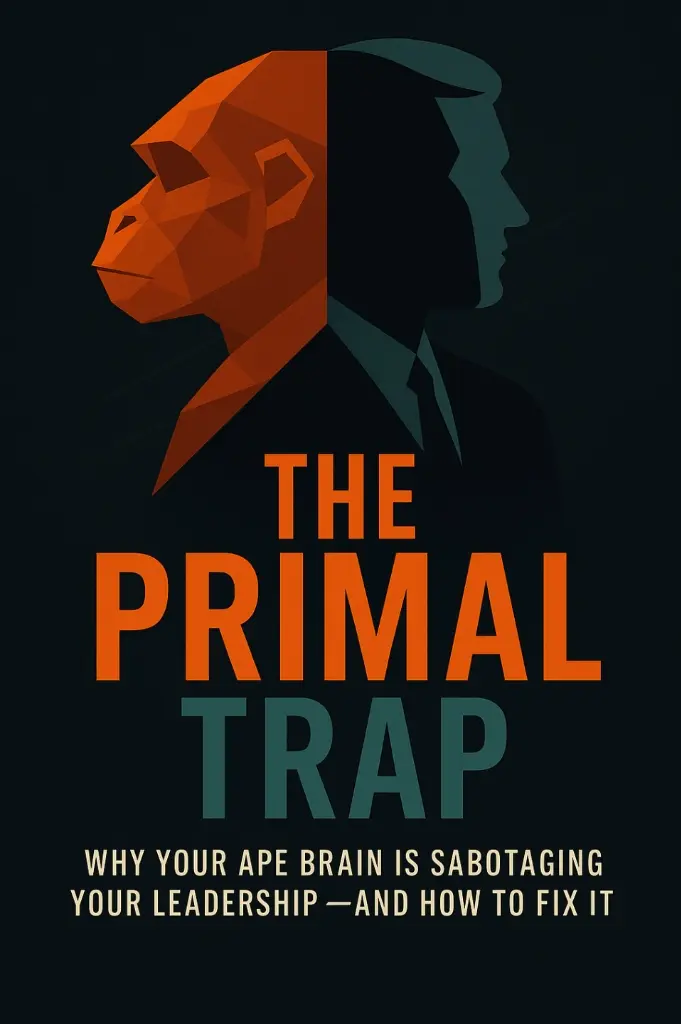
Smart leaders make their worst calls under pressure.
The Primal Trap explains why.
Under a board challenge, a missed quarter, or a key hire walking out, your survival wiring fires before your judgment catches up. The Primal Trap shows founders and operators how to spot that hijack and interrupt it before it costs them the decision.
Out now in paperback and Kindle. Join 500+ founders and operators Farzad has coached.
Want to read it first?
Get Chapter 1 free. It names the reflex behind your worst calls and maps the first 60 seconds of a hijack. Instant PDF, no payment, about 25 minutes.
You already know how to lead. That was never the problem.
You've read the books. You know what good leadership looks like. And this week you still snapped at the one person who told you the truth, or sat on a decision you already knew you had to make.
Most advice for that moment is vibes. A quote on a dark background. A morning routine that's supposed to undo twelve million years of evolution by 7am. It sells because it's comfortable. It fails because the problem was never information.
Under real pressure, your nervous system moves before your judgment does. You can't read your way out of a reflex. This book is about the reflex, and the gap you can learn to build in front of it.
These aren't endorsements. They're the companies where the founders, operators, and ICs Farzad has coached do their work, from VPs shaping strategy to engineers shipping the thing that ships.

 Slack
Slack  Combinator
 Blackstone


What Is The Primal Trap?
The Primal Trap is the moment your nervous system overrides your judgment. Pressure rises. A board challenge. A key hire threatening to leave. A quarter slipping sideways. Your brain can't tell a competitive threat from a physical one, so it runs the same fight-or-flight wiring that kept your ancestors alive on the savanna.
In neurological terms, the amygdala fires before the prefrontal cortex can intervene. Cortisol floods the body. Heart rate climbs. Peripheral vision narrows. The executive functions you depend on for judgment (nuance, empathy, long-term planning) go offline. What remains is a fast, blunt survival system optimized for escaping predators, not running companies.
The result is a leader who feels certain and decisive in the moment but is actually operating from a threat response. Decisions made in this state tend to be rigid, short-term, and self-protective. Exactly the opposite of what the situation requires.
Founders on working with Farzad.
Coaching reviews from the founders, operators, and PMs Farzad has worked through these patterns with.
"Farzad's coaching is a blend of strategic acumen, personal insight, and practical wisdom. The way he helps map out the challenges and get to clarity on a path forward is really powerful."

"Farzad's mentorship was transformative. He instilled confidence and helped me focus on what truly mattered in my career."

"It's a lonely existence as a startup founder, but even worse, our ideas and assumptions largely go unchallenged. The result is that we've already started 2024 seeing big wins and are on track for our best year ever."

"Farzad's coaching was exactly what I needed during a pivotal moment in my career. I turned what felt like a step back into a leap forward."

"Farzad's approach is honest, direct, and tailored to each founder's unique needs. A true expert in his field."

"A smart, resourceful, and optimistic coach. A clear thinker who provides frameworks that let you approach obstacles from a fresh perspective."
"Finding Farzad was one of the greatest things to happen on my startup journey. I've never worked with a mentor who can walk through your struggles with such clarity."

"Farzad has a special gift for understanding the psychology of business. He explores the needs of leaders and removes barriers that block productivity."

Your Ape Brain is Hijacking Your Leadership
Every high-performing leader carries a hidden vulnerability: ancient biological wiring operating in modern boardrooms. Under pressure, real or perceived, this ancient wiring activates and consumes leaders with anxiety.
It reads status threats as physical danger, uncertainty as a threat to survival, and conflict as something to dominate or escape. The result is fear dressed up as confidence, aggression disguised as decisiveness, and withdrawal masquerading as strategic thinking.
This is how smart leaders end up making disastrous decisions. It's how trust erodes, culture turns political, and organizations drift toward failure without fully understanding why.
You've felt it. The email you fired off before your judgment caught up. The hire you held onto six months too long because letting go felt like losing. The book gives that reflex a name, and names the twelve shapes it takes.
The first 60 seconds of a hijack, mapped.
- 0 sec
Trigger Lands
Board pushback. A missed number. A critical message hits the screen.
- Sub-second
Amygdala Fires
Faster than conscious thought. The body is already preparing to defend.
- Within seconds
Body Responds
Cortisol releases. Heart rate climbs. Peripheral vision narrows.
- If you interrupt
Prefrontal Cortex Returns
Otherwise the reaction commits and feels like a decision.
The entire sequence runs before you "decide" anything. The work isn't preventing it. The work is the gap.
The Three Traps Most Founders Run
The Primal Trap shows up as a family of recurring patterns. Each one has a name. Naming the trap is the first move that makes everything else possible. Here are three that run most founders. The book names twelve.
The Status Trap
You treat a question from your team as an attack on your authority. You answer the threat instead of the question. The next signal arrives later, or never.
The Control Trap
Delegation feels like exposure, so you hold the wheel. The org bottlenecks at your calendar. Senior hires churn first.
The Scarcity Trap
You make decisions from the part of your brain that still believes winter is coming and the tribe will starve. Short-horizon calls strip the conditions long-horizon work needs.
Recognize one of these in yourself?
The book names all twelve, and the reflex underneath them.
Buy The Primal Trap on AmazonOr get Chapter 1 free. Instant PDF, no payment.
Recognition Comes Before Regulation
You can't eliminate the threat response. It fires whether you want it to or not. The work is building the gap between trigger and reaction so judgment has a chance to catch up.
The Primal Trap draws on three established traditions for that work: Stoic philosophy for the mind, cognitive-behavioral therapy for the thought patterns, and mindfulness for the body. None of the three is new. The book's contribution is the synthesis, plus the operating model underneath: the Business Hierarchy of Needs.
The first chapter introduces the mechanism. Why your nervous system reads disagreement as predator, short-term certainty as safety, and ambiguity as starvation. Recognition is the first move. The rest of the book teaches what comes after.
The Concepts Behind the Frameworks
None of this is novel science. The Primal Trap synthesizes well-established research from neuroscience, organizational psychology, and stress physiology and translates it into language and steps that founders and operators can actually use under pressure. The references below point to the underlying ideas; they're starting points, not credentials borrowed for authority.
-
Behavioral Economics & Decision-Making
Decisions made under emotional load are systematically different from decisions made in a regulated state. The book leans heavily on Kahneman's dual-process model and the cognitive biases that follow from it.
Reference: Kahneman, D. Thinking, Fast and Slow.
-
Psychological Safety In Teams
Amy Edmondson's research at Harvard Business School established psychological safety as a measurable predictor of team performance. It's also the foundational layer in the Business Hierarchy of Needs above.
Reference: Edmondson, A. The Fearless Organization (2018).
-
Stoicism, CBT & Mindfulness
The book integrates three established traditions for self-regulation. Stoicism for the mind, cognitive-behavioral therapy for the thought patterns, and mindfulness for the body. The synthesis, and how to run it under sustained pressure, is the book's contribution.
References: Aurelius, M. Meditations; Beck, A. (CBT); Kabat-Zinn, J. (mindfulness research).
Note: The Primal Trap describes leadership and decision-making patterns, not a clinical condition. Nothing on this page is medical advice or a substitute for working with a licensed clinician where appropriate.
Lead Beyond Survival
In The Primal Trap, Farzad Khosravi argues that many leadership failures aren't failures of intelligence or strategy. They're our 'Ape Brain' running unchecked, controlling us through unexamined, unnamed processes at play in modern organizations.
Drawing on sixteen years of research in neuroscience, psychology, behavioral economics, and operating experience building and scaling companies, Khosravi gives you the tools to do what most leaders never attempt:
Identify Triggers
Learn to identify the primal triggers that hijack critical decisions at the worst possible moment.
Disarm Invisible Forces
See the invisible forces eroding your culture and learn exactly how to disarm them before they cost you talent.
Conscious Awareness
Gain practical, science-backed frameworks for building the capacity to lead with awareness under genuine pressure.
The book opens at a Walmart.
My mom worked there for years. Managers changed her schedule without notice. Denied the training she asked for. Blamed her when chronic understaffing made the job impossible.
Some weeks she closed at 11pm and opened at 7am. She carried boxes through eight-hour shifts on a shoulder that burned and feet that screamed. She stayed quiet. She'd seen people fired for less, and she had a kid to feed.
The job didn't stay at Walmart. It came home in her voice, her patience, the silence at our dinner table. I learned early that my clean shirt and my ride to school cost her something she didn't have left to give.
Every one of those calls, the schedule, the ignored injuries, the withheld training, was made by someone protecting a number on a spreadsheet. They called it efficiency. It was moral decay with better paperwork.
That's the whole argument of this book. The decisions leaders make don't stay at work. They follow people home, into their families, into the next generation's sense of what work does to a person.
I spent sixteen years turning that into a framework. It starts at the bottom, with the one thing my mom's managers never gave her.
The Business Hierarchy of Needs™
Optimization happens from the bottom up.
Predictable Growth
Scalable success is a mathematical byproduct of reliable systems and decision loops that run on real data. Together they remove the founder as the primary bottleneck.
Efficiency
Eliminate high-friction activities. Use stronger systems and technical compounding to amplify team output without increasing headcount.
Sustainability
Protect the leader's biological capacity. Build a business that preserves mental energy, prevents burnout, and holds up over the long term.
Psychological Safety
The fundamental neurological requirement for innovation. When teams feel safe to fail, they solve complex problems without fear-based loops.

The Anti-Guru.
Years ago I sat in a sales seat where every call was recorded. One month my job was to collect a $99 payment from a woman who was clearly barely holding on. I couldn't do it. So I emailed her from my personal account, where the company couldn't track me, and told her I'd quietly let it go.
"Having someone actually listen to me and understand what I'm going through is so great. Compassion nowadays is lacking, and to see someone have it is amazing."
For years I thought that made me too soft for the job. It didn't. The incentives were set by people who never had to sit on that call and feel their stomach turn. Leaders think they set targets. What they actually set is the kind of person you have to become to hit them.
Farzad Khosravi is a three-time founder, fractional COO, owner of the snack brand Hot Date Kitchen, and ICF-trained executive coach working at the intersection of leadership psychology, company building, and AI systems.
He served as a fractional COO to high-growth companies including Humoniq (YC S25), where he helped secure an $8.5 million seed round, and Traversaal, reaching $500,000 in first-year revenue. Earlier, he built the Customer Success organization at Nylas from zero through their $120 million Series C expansion.
Over 500 founders coached. 171 five-star GrowthMentor reviews. Behind it is a 16-year effort to answer one question: why do smart leaders make bad decisions? Born in Iran, raised in Kentucky, he helps leaders see the forces that have been shaping them all along, and choose what leads next.
Questions About The Primal Trap
What is The Primal Trap?
The Primal Trap is the moment under pressure when a leader's nervous system overrides judgment. Survival biology (the same fight-or-flight machinery that kept ancestors alive on the savanna) fires before the prefrontal cortex can intervene, so the leader makes rigid, short-term, self-protective decisions while feeling certain and decisive.
Who is The Primal Trap for?
Founders, executives, and operators leading under sustained pressure: fundraises, board challenges, missed quarters, founder conflict, escalations. It's written for high-performing leaders who want to recognize and interrupt threat reactions before they damage culture, trust, or strategy.
Is this about neuroscience or leadership?
Both. The Primal Trap synthesizes well-established neuroscience and stress physiology (amygdala hijack, hot vs. cold cognition, sympathetic activation) and translates it into language and steps founders can actually use. It's grounded in the science but written as a practical leadership manual, not a textbook.
What is the Ape Brain in leadership?
Ape Brain is the shorthand this book uses for the threat-detection wiring that activates when a leader perceives status, identity, or financial danger. It's the survival system the amygdala runs. It reads disagreement as attack, uncertainty as predator, and conflict as something to dominate or escape, and it does this faster than conscious thought.
What do I get in the free chapter?
An instant PDF of the first chapter of The Primal Trap, delivered by email. No payment, no credit card. It introduces the Ape Brain mechanism and why smart leaders make their worst decisions under pressure. It also previews the Business Hierarchy of Needs, the operating model that runs underneath the rest of the book. About 25 minutes to read. Enter your email above and it's in your inbox in under a minute.
How does this connect to founder decision-making?
Most founder mistakes (premature firings, reactive pivots, defensive board responses, scorched-earth emails) aren't failures of intelligence. They're decisions made from a hijacked nervous system. The book gives founders a way to spot the hijack, regulate the body, and decide from strategy rather than from the trigger.
When the same hijack keeps repeating
For a closer look at the in-the-moment mechanics (the four-second interrupt, affect labeling, and what to do when your prefrontal cortex goes offline mid-meeting), read Amygdala Hijack in Leadership: Why Smart Founders React Badly Under Pressure. It's the practical companion to The Primal Trap and covers the five most common founder hijack triggers.
When the hijack stops being a moment
When the trap stops being a single blow-up and becomes the default (three months of pivots, an unresolved trade-off with a co-founder, an investor email you keep not answering), the work changes. The four-second interrupt isn't enough. You need a framework for the decisions themselves and a way to keep your nervous system functional for the long stretch.
Read How to Make Hard Business Decisions You Won't Second-Guess for the Clarity Compass and the 10-year regret test. They're the two tools I use with coaching clients when fear is the loudest voice in the room. Then read How Emotional Resilience Impacts Business Decisions for the longer arc: overwhelm as a clarity problem, Kahneman's narrow framing, and the input audit. It's for the months when reactivity is the dominant mode, not just the rare blow-up.