
Build Systems in Your Startup: No-Code Tools Are the Key

3x founder · Coach to 500+ founders
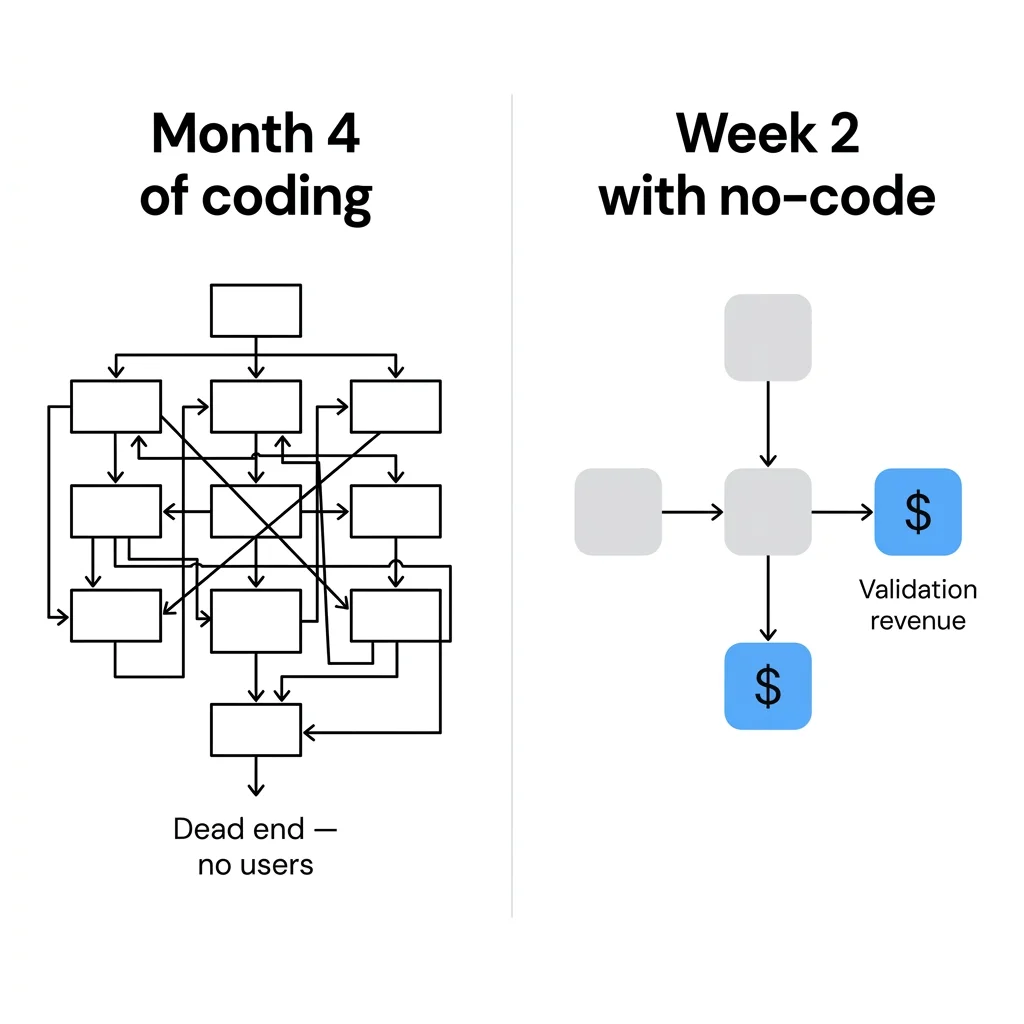
A technical founder came to me after spending four months building an MVP. Clean code. Good architecture. Zero users.
He’d spent the first month on the database schema. Month two on authentication. Month three on the dashboard. Month four polishing the UI.
He’d never shown it to a real user.
I asked him what he was trying to prove. He said he wanted to build something he was proud of.
That’s the wrong question to answer first.
Before you prove your engineering is solid, you need to prove someone wants the thing. Those are two different experiments, and most technical founders run them in the wrong order.
What no-code is actually for
The myth technical founders tell themselves: “I’ll validate after I build.” It sounds responsible. You’re building the real thing, not a prototype held together with duct tape.
It’s usually backwards.
No-code tools aren’t about building something cheap. They’re about proving demand before you invest months of real engineering. The goal is to reach a paying customer, a confirmed waitlist, or a clear “no” as fast as possible. Then you build with conviction.
No-code has two distinct use cases, and confusing them is where founders get into trouble.
Validation tools. You’re using no-code to test whether a market exists. Speed is everything. Quality is beside the point. You’re building enough product to tell you if someone will pay before you’ve written production code. If it works, you build. If it doesn’t, you pivot. Two months saved.
Internal operations tools. You’re using no-code to run the business: automating a workflow, building an internal dashboard, connecting two tools that don’t talk to each other natively. These live alongside your product, not before it.
Most of the “no-code for startups” advice conflates these two uses. A Bubble app for your MVP is a validation tool. A Zapier automation that routes leads to your CRM is an operations tool. They serve different purposes and get chosen at different stages.
Start by asking: am I validating demand, or am I running an operation?
No-code as a fake-door testing tool
The fastest use of no-code isn’t building a functional app. It’s building a fake door.
A fake door is a landing page that promises a solution, drives real traffic to it, and measures conversion before a single line of real code gets written. If people sign up, pre-order, or fill out a detailed intake form, you have signal. If they don’t, you have signal faster than six months of building would have given you.
Here’s what that looks like in practice:
- Write a one-paragraph description of the problem you’re solving and who it’s for. Be specific.
- Build a landing page on Webflow or Framer in a day or two. Include a sign-up form with a real ask: email plus one qualifying question.
- Drive traffic with $200 of paid ads or direct outreach to your target customer on LinkedIn.
- Measure who signs up and why. Talk to the first 10 people.
If you can’t get 20 qualified signups from $200 and targeted outreach, the positioning or the market is wrong. That’s a $200 lesson instead of a four-month build.
The strongest version of this is pre-selling. Ask for a deposit or a letter of intent before you build anything. If someone won’t commit $100 or sign a letter, their enthusiasm is not reliable signal. The Wallet Vote Meter runs from weakest to strongest: likes, email opt-ins, surveys, meetings, data sharing, prepayments, renewals. Prepayment is real signal. Everything above it is noise.
The no-code stack worth knowing in 2026
The tools have matured significantly since 2023. Here’s what actually gets used by founders I work with:
For validating a web app: Bubble is still the most capable platform for complex logic and real app functionality. Webflow for marketing-heavy products where the site is the product. Framer for fast, design-led landing pages when you’re testing messaging before building.
For internal tools and operations: Retool for internal dashboards and admin panels that need real data. Airtable for lightweight databases with a built-in frontend your team can use without a developer. Notion for team wikis, SOPs, and operational knowledge that needs to stay in one place.
For automation: Make.com for complex multi-step workflows between tools. Zapier if your team is non-technical and needs something they can manage without support. n8n if you want open-source control and don’t mind the setup cost.
For turning data into an app: Glide for apps built on top of a spreadsheet. Softr for client portals and member-facing tools built on Airtable data.
Pick one tool per use case. Don’t accumulate no-code tools the way you’d accumulate SaaS subscriptions.
When to stop using no-code
No-code has a ceiling. Knowing when you’ve hit it saves you from the founder who builds their entire product on Bubble and then spends nine months migrating it when the architecture can’t scale.
Three signals that you’ve outgrown it:
You’re fighting the tool. You’re spending more time working around platform limitations than building product improvements. That’s engineering time in disguise, and it’s more expensive than hiring a developer.
Collaboration is breaking down. Most no-code platforms have limits on version control, permissions, and team workflows that become painful past five or six people. When your team starts working around the platform rather than inside it, you’ve hit the ceiling.
You have paying customers and a validated use case. This is the right moment to bring in a developer. Not before. Once you know what to build, you can build it right. Building it right before you know what it is wastes the most expensive resource you have: time with real users.
Where no-code fails quietly
A few failure modes worth knowing before you start:
Scalability assumptions. No-code apps can get slow and expensive at volume. This is fine at the validation stage. It becomes a problem if you try to scale on no-code instead of treating it as a bridge.
Compliance constraints. If your product needs HIPAA, SOC 2, or GDPR controls at the infrastructure level, check the platform’s documentation before you build. Some platforms give you the controls you need. Others don’t, and you’ll discover this at the worst possible time.
Hidden technical debt. No-code looks like zero debt. It isn’t. When you rebuild in real code, you rebuild everything. Plan for that cost from the start so it doesn’t surprise you when you’ve already made promises to customers.
The mindset that makes no-code work
No-code tools are not a shortcut to avoid learning your business. They’re a shortcut to learning your business faster.
The founders who use them well treat every no-code build as a time-limited experiment. They set a clear goal before they start: what signal am I looking for? How will I know if this worked? What’s the trigger to rebuild in real code?
The founders who struggle treat no-code as a permanent solution and are surprised when it stops working at scale.
Use it fast. Learn from it. Then build the real thing.
The decision of when to use no-code, when to hire a developer, and when to use an agency is in the No BS Startup Guide.
Book a free strategy call if you want to map the right build path for your stage.
The best validation is a paying customer. Build only as much as it takes to get one.
Related Startup Guides
All articlesScale
Using AI to Build Systems in Your Startup
The best AI tools for startups mean nothing without systems worth automating. Here is the 4D framework founders use to build AI systems that actually compound.
Scale
How to Find Investors and Raise Startup Funding in 60 Days
Find the right investors, build a pitch deck that earns meetings, and run cold outreach that books calls. The 3-step process behind an $8.5M YC S25 raise.
Launch
Startup Pricing Strategy: You're Undercharging by 3-5x
A client went from $19 to $149 a seat in one week and converted better. The framework: 3 pricing models, a 10-prospect price ladder, when to raise.
Farzad Khosravi
No BS Startup Coach · 500+ Founders Coached
I help early-stage founders launch, grow, and lead with clarity. I cut through the noise to the few tactics that actually change your numbers. I've coached 500+ founders across validation, growth, leadership, and fundraising.