
Startup Customer Onboarding: How to Get It Right

3x founder · Coach to 500+ founders
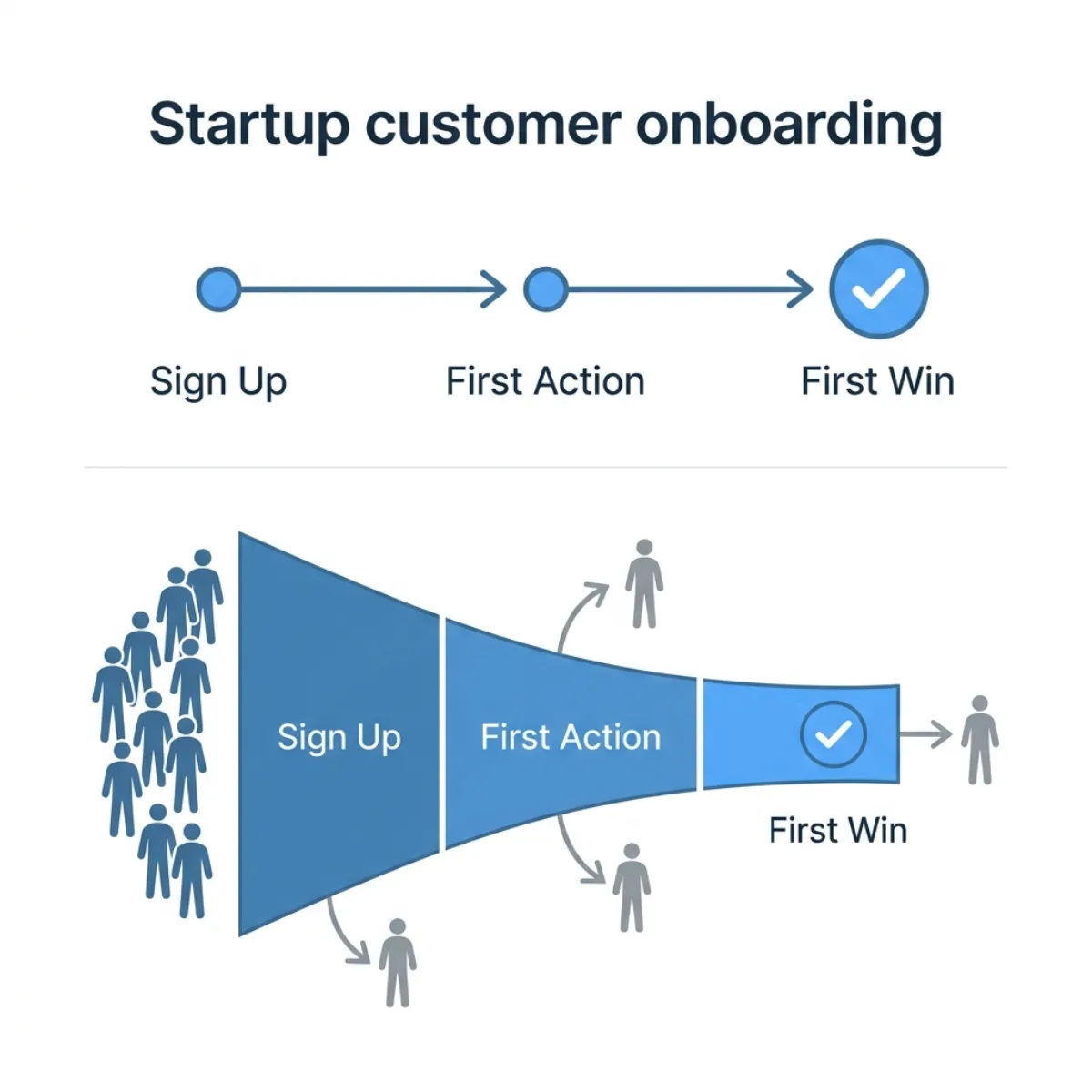
A founder I work with had 600 signups in a month after a strong Product Hunt launch. He came to our next session excited. Within a week, 7 people were still using the product.
He thought he had a marketing problem. He needed more traffic. Better cold emails. A PR hit.
He had a bucket with holes in it.
The 600 signups were real. The acquisition channel worked. But the first 10 minutes after signup were broken, and nobody had tested them. New users hit the dashboard, didn’t know what to do, and left.
That’s the onboarding gap. It’s the most common and most expensive problem at the early stage.
Why onboarding is the highest-ROI fix at the early stage
The math on broken onboarding is hard to ignore.
If it costs you $50 in paid acquisition to bring in a new user, and 90 percent of those users leave in the first week, you’ve spent $500 to get one person to stay. That’s before you’ve paid anyone to support them, marketed to them again, or built the next feature.
Every dollar you put into acquisition before you’ve fixed your first-session experience is a dollar with a hole in it.
The founders who compound fastest are not the ones running the best ad campaigns. They’re the ones who fixed the first 10 minutes after signup. Because once you’ve done that, every acquisition dollar you spend goes further.
The mistake founders make with onboarding
Most founders think onboarding means explaining the product. A feature tour. A getting-started checklist. A welcome email with a link to a help doc.
That’s not onboarding. That’s documentation.
Onboarding has one job: get the user to one win before they leave.
Slack figured this out early. New users can send their first message in under 90 seconds. Dropbox made file sync the onboarding. Notion gives every new user a sample page so the product is already working before they’ve done anything. The first win is baked into the flow, not bolted on afterward as a tutorial.
If your onboarding is a feature tour, you’re teaching. You should be getting the user to a win.
The 5-minute rule
Your onboarding window is shorter than most founders expect.
Users who don’t experience value in their first session almost never come back. The pattern holds across SaaS categories: the first session defines whether someone becomes a user or a churn stat.
Your goal is not “understand the product.” Not “see all the features.” One win. Before they close the tab.
For a project management tool, it’s creating the first task. For a CRM, it’s importing one contact. For a payroll tool, it’s running a mock payroll. For a content tool, it’s publishing one piece.
Map your product to that question: what is the smallest, fastest action that makes a new user feel like the product worked?
Everything in your first session should point toward that one action. Remove any step between signup and that moment that isn’t strictly necessary. Every extra click is a leak.
Three triggers, not a tour
Most onboarding email sequences run on a timer: Day 1, Day 3, Day 7. Welcome emails, feature highlights, tips and tricks.
They’re also easy to ignore, because they arrive regardless of what the user did.
Behavior-based triggers work differently. Instead of sending an email because it has been 24 hours, you send it because a user completed a specific action or failed to complete one.
Three triggers worth building:
The activation trigger. When a user completes the key onboarding step, send a message that confirms what just happened and names the next move. “You just connected your calendar. Here’s how to run your first report.” This is the moment they’re most engaged. Use it.
The stall trigger. If a user signed up but hasn’t reached the first win in 48 hours, send a plain-text email from a real name. Not “Our team at [Product].” From a person. “Hey, noticed you haven’t set up your first project yet. Anything blocking you?” Three sentences. Genuine curiosity.
The churn signal. If a user goes seven days without logging in, the habit hasn’t formed. Act before they forget you exist. One email asking what happened surfaces more information than three asking them to come back.
How to find your activation moment
Most founders know their product needs an activation moment. Fewer know how to identify the right one.
Start with your best users. If you have 20 customers who pay reliably and keep coming back, look at what they did in their first session that your churned users didn’t. That behavioral difference is usually the activation signal. It’s rarely a feature. It’s almost always one specific action.
If you don’t have customers yet, build a hypothesis with three questions:
- What’s the shortest path from signup to the outcome the user actually came for? Strip every step that isn’t strictly required.
- What would a new user have to accomplish for them to recommend the product to someone else in the first week?
- When does the product feel like it’s working, rather than like it might eventually work?
The activation moment is almost always one step, not a sequence. Slack: send one message. Dropbox: sync one file. Linear: close one issue. The rest of the product matters, but the activation moment is the one thing that makes the rest feel real.
Once you’ve named it, build your entire first-session experience around getting every new user there. Remove any step that doesn’t serve that path. The checklist items that don’t point toward that moment are noise.
Onboarding doesn’t end at activation
Getting someone to activate once is not the same as building a habit.
Duolingo is the clearest example of this: the product is engineered to bring you back. Streaks, reminders, completion signals. Onboarding doesn’t end when you finish your first lesson. It ends when you’ve come back seven days in a row.
For most startups, the equivalent isn’t that elaborate. But the principle holds.
Map the first 30 days after signup. Which actions do users who stay engage in more? What happens in week one that predicts whether someone is still around in month two?
That’s your retention anchor. Build your onboarding to get every new user to that action as fast as possible.
The founder I mentioned at the start found that users who ran a specific report in their first week had four times the 90-day retention of users who didn’t. That one action became the center of their entire onboarding sequence. Everything else was reorganized around getting new users there.
How to measure whether your onboarding is working
Three numbers worth tracking from day one:
Activation rate. The percentage of signups who reach your defined “first win” within their first session. If this is below 40 percent, your onboarding has a structural problem. If it’s below 20 percent, that’s the biggest bottleneck in your entire business, and no amount of acquisition spend will fix it.
Time to first value. How long it takes from signup to the first win, measured in minutes. Benchmark against the best in your category. For a productivity tool, Notion gets a user creating a page in under two minutes. For a communications tool, Slack gets a message sent in under 90 seconds. You don’t need to match them, but you should know where you stand.
Day-7 retention. The percentage of users who come back in the first week after signing up. This is the leading indicator of whether the habit is forming. Users who return within seven days have dramatically higher 30-day and 90-day retention than users who don’t.
You don’t need a sophisticated analytics stack to track these. A spreadsheet with cohort data works at the early stage. What matters is that you’re looking at the numbers weekly, not monthly.
Tools worth knowing at the early stage
PostHog is open-source, free to start, and tracks activation funnels, cohort retention, and session recordings out of the box. Install it in a day. It’s usually the first analytics tool an early-stage SaaS needs. Mixpanel is the alternative if you want a more polished reporting interface and don’t need the open-source option.
For behavior-triggered emails: Customer.io and Intercom both let you fire sequences based on specific user events rather than arbitrary timers. You define the event (user completes setup step, user goes 48 hours without the activation action), and the email fires automatically. Both have low-cost tiers for companies under a few hundred users.
The failure mode here is waiting for the perfect stack before you start measuring. You don’t need all of this at once. Start with one metric: activation rate. Track it weekly. Decide what to fix first based on what you find. Add the rest as the questions get more specific.
If your activation rate is above 50% but users still aren’t sticking past week two, onboarding isn’t the problem. The product habit isn’t forming. The SaaS retention breakdown covers what retention actually looks like by stage and where most companies lose users after activation.
Where onboarding breaks
Three failure modes that come up consistently:
Too many steps. Every step between signup and first value is a potential leak. Audit your flow. How many clicks does it take to reach the first win? Cut anything that isn’t strictly necessary.
Feature tour first. Showing users what’s possible before they’ve accomplished anything doesn’t build confidence. It creates overwhelm. Lead with the outcome they signed up for, not the capability you built.
No human backup. Automated sequences miss edge cases and personal situations. Someone on your team should be watching drop-off points and reaching out manually to users who stall in the first 48 hours. Personal outreach plus automated sequencing is consistently more effective than either alone.
The full framework for fixing activation, retention, and funnel leaks across the full customer lifecycle is in the No BS Startup Growth Playbook.
Book a free strategy call if you want to map exactly where users are dropping out of your funnel.
Most retention problems are solved in the first 10 minutes after signup. Fix that window and everything downstream gets easier.
Related startup guides
Use the startup guide to see onboarding in the full customer lifecycle. Once activation is working, the startup pricing strategy guide shows how to capture more value from the users you’re successfully retaining.
Related Startup Guides
All articlesLaunch
Build Startup Products Your Customers Come Back For
The founder who listens before building beats the one who ships first and asks later. How to build startup products customers actually use and keep using.
Launch
How to Build an MVP (2026 Founder Guide)
How to build an MVP that actually validates your idea: a four-stage order to scope, build, test, and iterate without burning runway on the wrong features.
Launch
Startup Pricing Strategy: You're Undercharging by 3-5x
A client went from $19 to $149 a seat in one week and converted better. The framework: 3 pricing models, a 10-prospect price ladder, when to raise.
Farzad Khosravi
No BS Startup Coach · 500+ Founders Coached
I help early-stage founders launch, grow, and lead with clarity. I cut through the noise to the few tactics that actually change your numbers. I've coached 500+ founders across validation, growth, leadership, and fundraising.